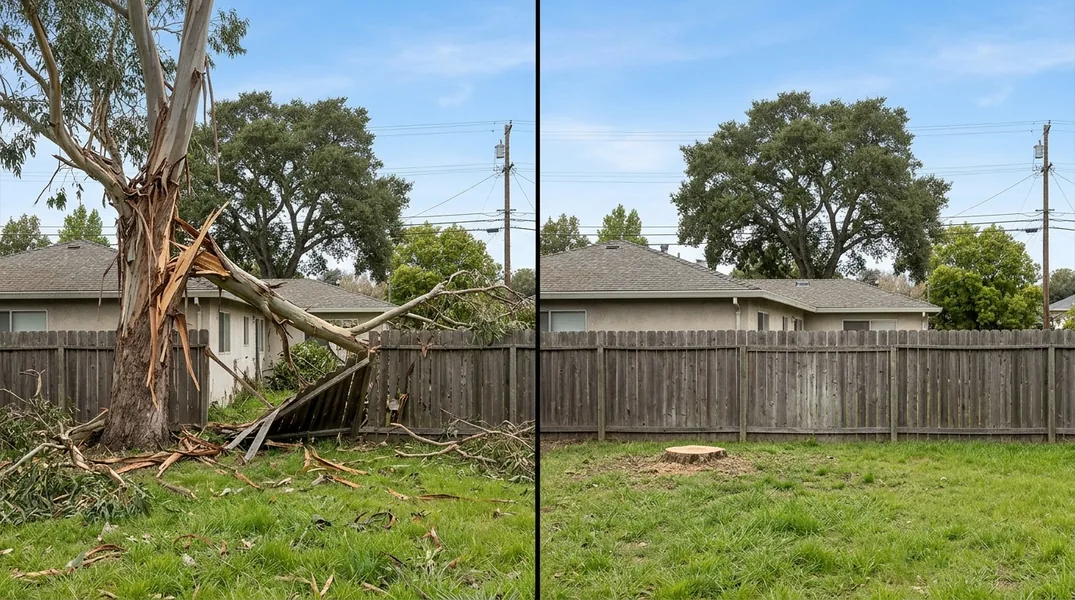
Understanding the Difference: Trimming vs. Removal
When you look at a struggling tree in your yard, the question isn't always clear: does it need care, or does it need to go? Many homeowners in Salinas face this exact dilemma. The good news is that there's a real difference between Tree Trimming & Pruning and Tree Removal, and understanding that difference can save you money and help your landscape thrive.
Tree Trimming & Pruning is a maintenance practice designed to keep a tree healthy, encourage new growth, and improve its appearance. It involves removing dead branches, thinning the canopy, and shaping the tree to promote better structure and air circulation. Tree Removal, on the other hand, is the complete extraction of a tree from your property. This is typically a last resort, reserved for trees that pose safety risks, are diseased beyond recovery, or are simply incompatible with your landscape plans.
The key to making the right choice lies in understanding your tree's current health, your goals for your property, and the professional assessment of an experienced arborist. At Salinas Tree Service, we help homeowners navigate this decision every day by providing honest, expert evaluations that put your tree's wellbeing first.
Signs Your Tree Is a Candidate for Trimming and Pruning
A healthy tree often just needs regular maintenance to reach its full potential. If your tree exhibits certain signs, trimming and pruning may be all it needs to thrive for years to come. Trees that are still actively growing, showing green foliage, and producing new branches are generally excellent candidates for professional pruning services.
Look for trees with dead or diseased branches that can be selectively removed without compromising the overall structure. If your tree has crossed or rubbing branches, excessive density that blocks sunlight to your home or yard, or branches that hang over your roof or power lines, these are all situations where strategic trimming makes sense. Young trees also benefit tremendously from early pruning, which establishes a strong framework and prevents problems down the road. Trees that have suffered storm damage but still have a solid trunk and living wood are often restorable through careful pruning and branch removal.
The goal of trimming is to enhance the tree's natural form while removing problem areas. When done correctly by an experienced arborist, pruning actually extends a tree's life and improves its health. This is why regular maintenance pruning is one of the smartest investments a homeowner can make in their landscape.
When Tree Removal Near Me Becomes Necessary
There are situations where a tree has simply reached the end of its life or poses too great a risk to remain standing. Understanding these warning signs helps you make an informed decision about whether Tree Removal is the right choice for your Salinas property.
A tree should be considered for removal if it shows signs of severe disease or pest infestation that cannot be treated. If more than 50 percent of the canopy is dead or dying, the tree is unlikely to recover. Trees with significant structural damage, a severely leaning trunk, large cavities in the wood, or multiple large cracks are safety hazards that may need removal. If the root system is damaging your foundation, driveway, or septic system, removal might be the only practical solution. Trees that have been struck by lightning, uprooted during a storm, or damaged so severely that they cannot be safely pruned are also candidates for removal.
Additionally, if a tree is simply in the wrong location for your property, blocking views, damaging utilities, or creating excessive shade where you want sunlight, removal allows you to reimagine your landscape. Dead trees serve no purpose and can become unpredictable hazards, especially during high winds or storms. An arborist will evaluate all these factors before recommending removal.
How a Professional Arborist Evaluates Your Tree
The decision between trimming and removal shouldn't be made by guesswork. An experienced arborist brings years of training and experience to assess your tree's condition accurately. When you call Salinas Tree Service for an evaluation, our team looks at multiple factors to determine the best course of action for your specific situation.
First, an arborist examines the overall health of the tree by checking for signs of disease, pest damage, and structural integrity. They look at the bark for cracks, splits, or unusual discoloration. They assess the canopy's density and color, checking for dead branches, sparse foliage, or signs of stress. The arborist also evaluates the tree's structure, looking for weak branch angles, included bark, or a compromised trunk. They may even use specialized tools to test wood density and detect internal decay that isn't visible from the outside.
Beyond the tree itself, an arborist considers your property and goals. They evaluate the tree's location relative to your home, utilities, and other landscape features. They ask about your vision for your yard and whether the tree supports or hinders that vision. They also factor in the tree species, age, and growth rate. Some trees are naturally short-lived, while others can thrive for centuries with proper care. This comprehensive evaluation ensures that the recommendation is based on facts, not assumptions.
Tree Removal Cost in Salinas: What to Budget
Cost is naturally a concern for homeowners considering either trimming or removal. The pricing for these services varies based on tree size, location, condition, and complexity. Generally speaking, trimming and pruning are significantly less expensive than complete removal because they require fewer hours of labor and equipment.
A routine trimming job for a medium-sized tree typically costs less than removal of the same tree. However, if your tree requires extensive pruning due to severe damage or disease, costs can increase. Tree Removal is more involved because it requires careful felling, cutting the trunk into manageable sections, removing the stump, and hauling away debris. Large trees, trees close to structures, and trees in difficult-to-access locations command higher pricing.
After removal, many homeowners also invest in Stump Grinding to eliminate the remaining stump and reclaim yard space. This is an additional cost but prevents future sprouting and creates a clean finish to your landscape. To get an accurate sense of what your specific situation will cost, we recommend requesting a free estimate from Salinas Tree Service. Our team will assess your tree and provide transparent pricing so there are no surprises.
Making Your Decision: Questions to Ask Your Arborist
Before committing to either trimming or removal, it's worth asking your arborist some key questions to ensure you're making the right choice. These questions will help you understand the reasoning behind their recommendation and feel confident in your decision.
Ask whether the tree can be saved and, if so, what ongoing care it will require. Inquire about the timeline for recovery if trimming is recommended, and how often the tree will need maintenance going forward. If removal is suggested, ask why it's necessary and whether there are any alternatives. Ask about the tree species and whether it's well-suited to the Salinas climate. Request a detailed explanation of any risks the tree poses and whether those risks can be mitigated through trimming. Finally, ask for a clear breakdown of costs and what the job will entail from start to finish.
A good arborist will answer these questions thoroughly and help you understand the reasoning behind their recommendation. If you're ready to get professional guidance on your tree, contact Salinas Tree Service today at (831) 243-3041 or request a free estimate. Our experienced arborists are ready to evaluate your trees and help you make the best decision for your property and your landscape's future.
Looking for a professional tree service contractor in Salinas? Salinas Tree Service responds fast for all your tree service needs.
Get a Free QuoteOur services: Tree Removal · Tree Trimming & Pruning · Stump Grinding